
The Indian tax is making historic transformation. With the rollout of PRARAMBH 2026, the Income Tax Department has launched a nationwide awareness campaign to introduce taxpayers to the Income-tax Act, 2025, which will come into effect from 1st April 2026.
This initiative marks not just a change in legislation, but a shift in mindset, administration, and taxpayer engagement. Through a comprehensive multimedia campaign spanning print, radio, television, outdoor media, digital platforms, and social media, the government aims to ensure that every taxpayer understands the new framework and adapts smoothly.
Let us break down what PRARAMBH 2026 means, the intent behind the new Act, and how it impacts taxpayers across India.
What is PRARAMBH 2026?
PRARAMBH 2026 is a nationwide awareness campaign launched by the Income Tax Department to educate taxpayers about the key features of the Income-tax Act, 2025.
The campaign reflects a broader vision—to make taxation:
- Simpler
- Transparent
- Taxpayer-friendly
- Easy to comply with
It signals the beginning of a new chapter in India’s taxation system, focusing on clarity, efficiency, and voluntary compliance.
A Transformational Message from Finance Minister Nirmala Sitharaman
At the heart of this reform lies a powerful message from the Finance Minister:
“You’re not just tax collectors. You’re the face of the government’s relationship with the taxpayer.”
This statement redefines the role of tax officers—from enforcement authorities to partners in nation-building.
She further emphasized:
- Tax administration must be carried out with empathy, fairness, and efficiency
- Officers must internalize the spirit of the new law
- Taxpayers are partners, not adversaries
Her inspiring line:
“Chhodo Kal Ki Baatein, Kal Ki Baat Purani; Aao Milkar Likhenge Hum Income Tax Ki Nayi Kahani.”
captures the essence of PRARAMBH, leaving behind complexity and embracing a modern, simplified tax regime.
Why Replace the Income-tax Act, 1961?
For over six decades, the Income-tax Act, 1961 served as the backbone of India’s tax system. However, over time, it became:
- Highly complex due to numerous amendments
- Burdened with provisos and explanations
- Difficult for taxpayers to interpret
The Income-tax Act, 2025 has been introduced to modernize and simplify this framework without changing the core tax policy.
Key Objectives of the New Act
- Simplify statutory language
- Improve structural clarity
- Reduce interpretational disputes
- Align with global tax standards
- Enhance voluntary compliance
Importantly, no new taxes have been introduced. The focus is purely on ease of understanding and compliance.
Major Structural Changes in the Income-tax Act, 2025
The new Act significantly reduces complexity while improving usability.
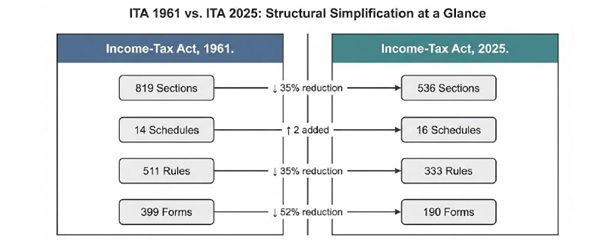
1. Reduced Sections and Simplified Drafting
- Old Act: 819 Sections, 14 Schedules
- New Act: 536 Sections, 16 Schedules
2. Key Simplification Measures
- Explanations and provisos merged into main sections
- Use of tables and formulas instead of lengthy text
- Removal of obsolete provisions
- Clear and direct cross-references
3. Simplified Rules and Forms
- Old Rules: 511 Rules with 399 Forms
- New Rules: 333 Rules with 190 Forms
This reduction directly translates into less compliance burden and easier navigation for taxpayers and professionals.
Source: Incometaxindia.gov.in
Introduction of the “Tax Year” Concept
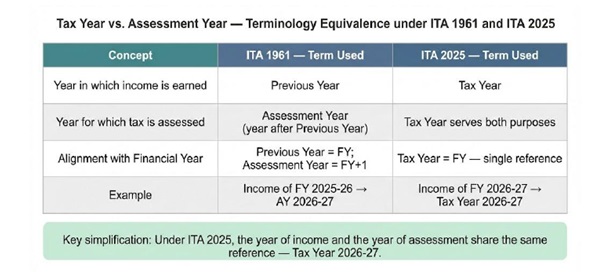
One of the most significant reforms is the introduction of the “Tax Year”.
Old System (Income-tax Act, 1961)
- Previous Year (income earned)
- Assessment Year (tax assessed)
- Result: Confusion due to dual-year references
New System (Income-tax Act, 2025)
- Single concept: Tax Year
- Defined as a 12-month period within a financial year
What This Means
- Income earned in FY 2026–27 will be called Tax Year 2026–27
- Eliminates confusion between “previous year” and “assessment year”
- Makes compliance more intuitive and taxpayer-friendly
This change is a major step toward simplification, especially for small taxpayers and first-time filers.
Transition from Old to New Act
The transition to the new regime has been carefully planned to avoid disruption.
Key Transitional Provisions
- The Income-tax Act, 1961 will be repealed from 01.04.2026
- However, past assessments remain valid
- Pending cases will continue under the old Act as per transitional rules
Impact on Taxpayers and Professionals
The Income-tax Act, 2025 is expected to simplify taxation for all stakeholders by making provisions clearer, more structured, and easier to follow. For individual taxpayers, the biggest benefit will be better understanding of tax laws, along with reduced confusion due to the introduction of a single “Tax Year” instead of the earlier previous year and assessment year concept. The return filing process is also likely to become simpler with fewer forms and streamlined procedures.
For businesses, the new Act brings greater clarity in tax planning and reduces ambiguity in interpretation. The overall compliance burden is expected to decrease due to fewer rules and simplified provisions, allowing businesses to focus more on growth and operations. This will also contribute to improving the ease of doing business in India.
For professionals such as Chartered Accountants and tax advisors, the law is now more logical and well-structured, making it easier to interpret and apply. With reduced scope for disputes and clearer provisions, professionals can provide more efficient advisory and compliance services, ultimately saving time and improving accuracy.
Final Words
The launch of PRARAMBH 2026 and the implementation of the Income-tax Act, 2025 mark a milestone in India’s tax reforms. By simplifying language, reducing complexity, and adopting a taxpayer-centric approach, the government is laying the foundation for a more transparent and efficient tax system.
As India moves forward, this reform is expected to build trust, improve compliance, and strengthen the relationship between taxpayers and the government.
The message is clear- this is not just a new law, but a new beginning.
Are you prepared for the shift to the new Tax Year system and the simplified Income-tax Act, 2025 starting April 2026?