
Tax reassessment cases often turn on complex questions of valuation, evidence, and interpretation. But sometimes the most powerful argument a taxpayer can make has nothing to do with the merits of the addition itself, it’s about whether the tax department followed the correct internal process before reopening the case at all. A recent ruling from the Income Tax Appellate Tribunal (ITAT), Delhi Bench in case of Mrunmayee Priyadarshini Pattnaik vs Income Tax OfficerITA No. 7985/Del/2025 :Asstt. Year: 2018-19, is a striking example of exactly this, and it’s a ruling every taxpayer facing a reassessment notice should know about.
The Background: Two Properties and a Big Addition
The case involved a Delhi-based individual taxpayer whose case was selected for reassessment after the tax department noticed she had purchased two properties in theconcerned year forconsideration of Rs.48,50,000/- havingstamp value of Rs.69,50,000/- along with basement forRs.4 ,00,000/- having stamp valuation of Rs. 31,00,000/-. Orderu/s 148A(d) was passed on31.03.2022. The source of wholepurchase of Rs.52 ,50,000/- remained unexplained (bothtransaction) and the assessee having purchased theseproperties for less than their stampvalue having a difference ofRs.48,00,000/- and as such total income of Rs.1 ,00,50,000/-remained unexplained and has escaped assessment. During there-assessment proceeding,opportunities were given to theassessee to explain the transaction and the considerationreceived there in. However, the Assessing Officer was notsatisfied and made addition of Rs.48,00,000/- u/s 56(2)(x) ofthe Act and also initiated penalty proceedings.
The taxpayer didn’t get much traction at the first appellate stage either; her appeal was dismissed because she hadn’t filed any response or supporting documents during those proceedings, and the addition was upheld on merits as well.
On the surface, this looked like a fairly straightforward case stacked against the taxpayer. But the real battle was fought, and won, on a completely different front.
The Real Issue: “Where Is Your Approval?”
Before the tax department can issue a notice reopening an old assessment under Section 148, the law requires the Assessing Officer to first obtain approval or sanction from a senior, designated authority under Section 151 of the Income Tax Act. This isn’t a mere formality. It exists as a check and balance, ensuring that the power to reopen someone’s settled tax assessment isn’t exercised casually or without senior-level scrutiny.
In this case, the taxpayer’s representative raised an additional legal ground at a late stage of the appeal, specifically arguing that the reassessment proceedings were invalid because the tax department had failed to provide proof of this Section 151 approval, despite the taxpayer having formally requested it through an RTI (Right to Information) application.
The Tribunal first had to decide whether it could even consider this new argument, since it hadn’t been raised earlier in the appeal process. It allowed the additional ground, relying on a well-established Supreme Court principle that purely legal questions, ones that don’t require digging up new facts and can be decided based on material already on record, can be raised and examined at any stage of appellate proceedings.
What the RTI Revealed
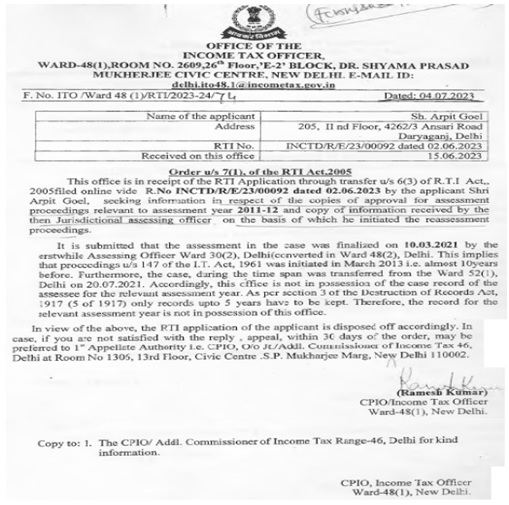
This is where the case takes an interesting turn. The taxpayer’s RTI application specifically asked for a copy of the request letter sent to the sanctioning authority and the actual approval granted under Section 151.
The response was telling. The department’s own record-keeping system, along with the physical file forwarded by the local tax office, showed that no such documents were available in the file or in their digital systems. When the Tribunal later asked the department to clarify this during the hearing, the assessing officer’s own office confirmed in writing that the relevant records sought under the RTI could not be located in the case file.
This is despite the fact that the formal order initiating the reassessment had specifically stated that it was being passed with the prior approval of senior tax officials, and that the notice reopening the case was being issued after obtaining that approval. In other words, the order claimed the approval existed, but when asked to produce it, the department’s own systems and files came up empty.
Why This Single Gap Was Enough to Quash the Entire Case
The Tribunal didn’t have to look far for precedent. It relied on an earlier Delhi Tribunal decision involving a different taxpayer, where an almost identical situation had played out: the tax department could not produce any record showing that approval under Section 151 had actually been obtained before reopening the assessment. In that earlier case, the Tribunal had held that when the reasons recorded for reopening a case don’t even mention whether approval was taken, and the department can’t subsequently produce evidence of such approval despite an RTI request, real doubt arises over whether the legally mandated approval was obtained at all. The absence of this approval was held to make the entire reassessment void from the start, not merely procedurally defective, but legally non-existent.
Applying the same reasoning here, the Tribunal concluded that since the department could not produce the Section 151 approval despite repeated requests, both during the reassessment proceedings and later through the RTI mechanism, the reassessment had been carried out without following the legally mandated procedure. This rendered the entire reassessment void ab initio, meaning void from the very beginning, as if it never had legal existence.
Because the reassessment itself was invalid, the Tribunal didn’t even need to examine whether the Rs 48 lakh addition was justified on its merits. The procedural defect was fatal enough to bring down the whole case, addition and all.
What This Means for Taxpayers Facing Reassessment
This ruling offers a few important, practical lessons for anyone dealing with an income tax reassessment notice:
Procedural safeguards built into the law, like the requirement of senior-level approval before reopening an assessment, are not mere technicalities. They are substantive protections, and the courts treat violations of these safeguards seriously enough to invalidate an entire assessment, regardless of how strong the underlying addition might otherwise be.
If you receive a reassessment notice and have doubts about whether proper procedure was followed, filing an RTI application to request specific documents, such as the approval under Section 151, can be a legitimate and effective tool. In this case, it was the RTI response itself that exposed the gap in the department’s record-keeping and became the foundation of the taxpayer’s winning argument.
Finally, this case is also a reminder that fighting only on the merits of an addition isn’t always the most effective strategy. Sometimes, examining whether the tax department followed its own mandatory internal procedures, right from the issuance of the original notice, can reveal a far stronger and more fundamental ground of challenge.
Disclaimer: This summary is based on a recent ITAT ruling and is intended for general informational purposes only. Reassessment proceedings under Sections 147/148 involve specific legal and procedural requirements. Readers should seek professional advice before taking any action based on this information. If you find any factual inaccuracies or outdated information in this article, please let us know and we will review and update the content accordingly.